
Sales and Customer Onboarding Kanban
A pipeline becomes hard to trust when account value, customer intent, commercial decisions, and implementation work are separated. The stage may be current while the next human action is missing.
This board treats every card as an account, not a generic task. ARR, the customer promise, the next decision, stakeholders, and the meaningful date form the visual hierarchy.
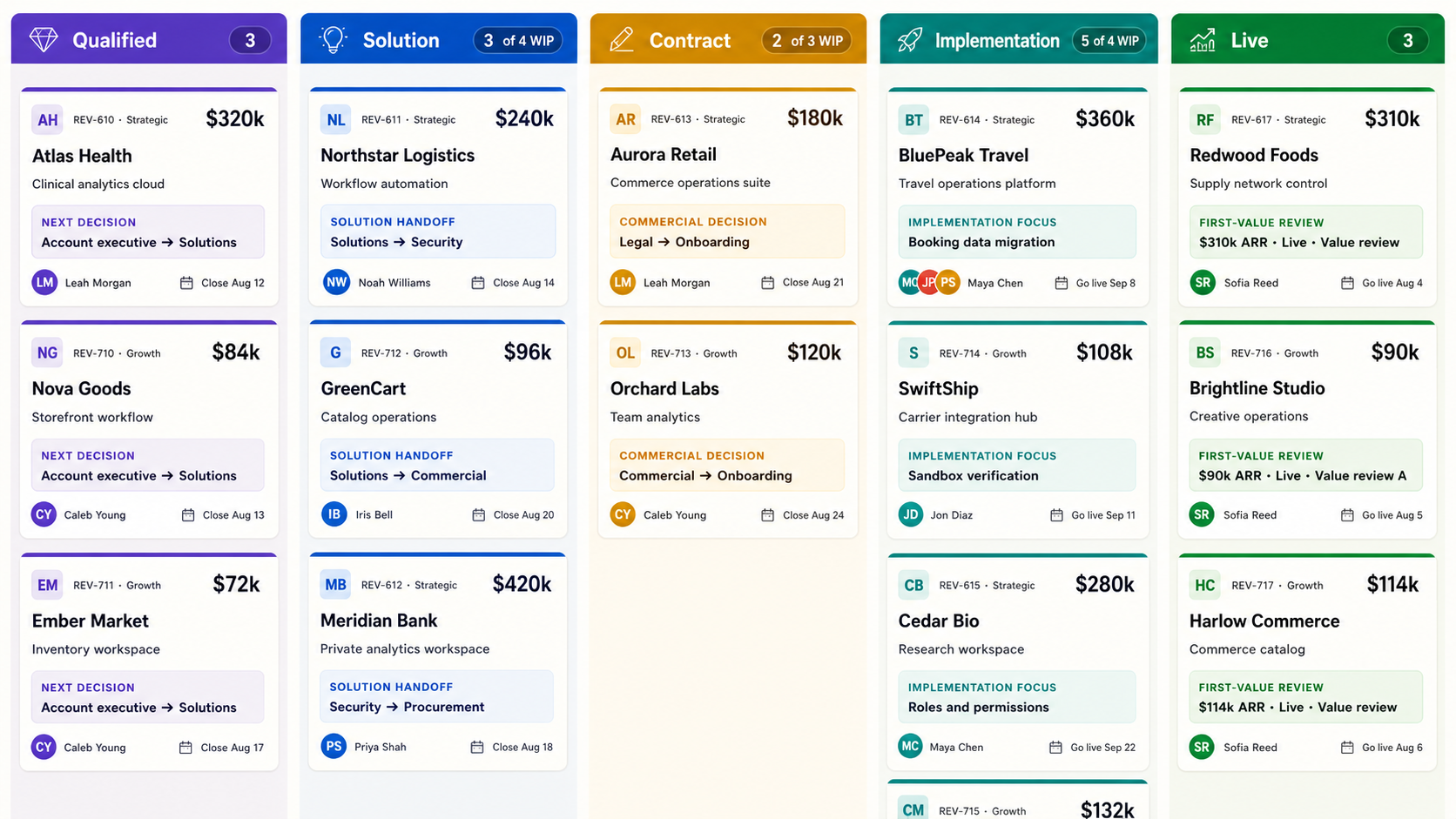
Carry customer context through the handoff
Qualified cards focus on discovery, solution cards on the specialist handoff, contract cards on the commercial decision, implementation cards on go-live work, and live cards on first value. That change in anatomy makes the workflow readable without adding more fields everywhere.
Treat risk as evidence, not priority
A high-value opportunity is not automatically unhealthy. Risk styling should appear only when a named blocker exists, such as an ownerless security handoff or a decision that threatens the launch date.
Keep CRM and delivery systems authoritative
Your application owns accounts, contacts, forecasts, commercial permissions, implementation records, and accepted updates. The Kanban is a programmable working view over those records.
Evaluate with a real customer journey
- Use representative ARR, stakeholders, decisions, and launch dates.
- Confirm account and next action stay readable after media scaling.
- Test a blocked implementation handoff and an over-capacity stage.
- Decide which fields can move with a card and which require server validation.
Related guidance: RevoGrid Kanban, workflow columns, and Pro trial access.